
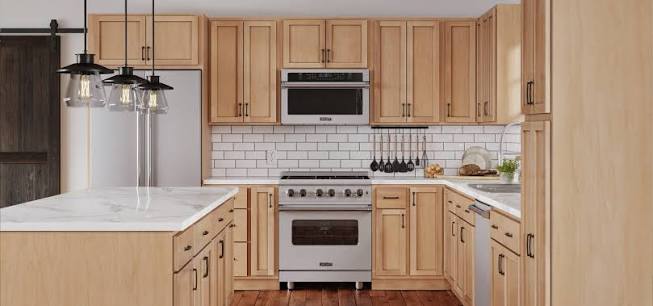
If you own a home in Naples, Marco Island, Bonita Springs, Estero or Fort Myers, replacing your windows is not a cosmetic decision. If you have started planning a kitchen in Naples, Marco Island or Bonita Springs, you have almost certainly come across the term “Amish cabinetry” — usually presented as the premium option, rarely explained. Homeowners assume it describes a look: rustic, country, heavy oak. It does not. Amish cabinetry describes how the cabinets are made and who makes them, and the result can be anything from a flat-panel walnut kitchen in a contemporary high-rise to a painted inset scheme in an Old Naples residence.
This guide explains what you are actually buying, where the extra cost goes, and how handcrafted cabinetry behaves in a coastal Florida home over the long term.
Amish cabinetry is a method, not a style
Amish cabinetry comes from small family workshops, concentrated in communities in Ohio, Indiana and Pennsylvania, where woodworking is a trade passed down through apprenticeship rather than a job learned on a production line. A cabinet is built by a craftsman who is responsible for it from rough lumber to finished piece, in small batches, to the dimensions of your specific room.
That structure produces a particular set of consequences. There is no standard size catalog to design around, because nothing is pre-built. There is no assembly-line tolerance stack, because a single pair of hands controls the joinery. And there is no incentive to substitute a cheaper substrate to protect a margin, because the shop’s reputation travels by word of mouth through builders and designers rather than through advertising.
What you are paying for, in other words, is not decoration. It is construction.
Inside the build: what handcrafted actually means
Solid hardwood face frames and doors
Face frames and door frames are milled from solid hardwood — maple, white oak, cherry, walnut, hickory — rather than assembled from wrapped composite. Door frames are joined with mortise-and-tenon joinery, which resists racking and holds a crisp reveal for decades. On a factory door, that same joint is often a cope-and-stick profile held with glue and a fastener; it looks similar on day one and behaves differently on year fifteen.
Dovetailed solid-wood drawer boxes
Drawer boxes are solid wood with dovetailed corners, not stapled particleboard with a wrapped finish. This is the single easiest quality check any homeowner can perform in a showroom: pull a drawer out completely, turn it slightly, and look at the corner. Interlocking dovetail joints mean the box is carrying load through wood rather than through fasteners, which is what allows deep drawers to hold heavy cookware without sagging or racking.
Plywood cabinet boxes
Boxes are built from furniture-grade plywood rather than particleboard or MDF. In Florida this matters more than it does anywhere else in the country. Particleboard swells irreversibly when it takes on moisture — a dishwasher leak, a slow supply-line drip under a sink, a hurricane-season power outage in an unoccupied house — and once it has swollen, the only repair is replacement. Plywood tolerates the same events and dries out.
Hand-applied, catalyzed finishes
Finishing is where the difference is most visible and least discussed. Handcrafted cabinetry is sanded by hand between coats and finished with catalyzed conversion varnish or a comparable durable system, applied in controlled conditions. The result is a surface with depth and evenness that holds up to cleaning products, sunlight and humidity. Rushed factory finishes are thinner, and they show it first at the places your hands touch every day: drawer edges, the cabinet next to the range, the door beside the sink.
Modern hardware, traditional carcass
One common misconception is that handcrafted means old-fashioned mechanics. It does not. Amish shops use the same premium European hardware specified in any high-end kitchen — full-extension soft-close undermount slides, concealed adjustable hinges, integrated organizers, lift systems. The traditional part is the box and the joinery. The moving parts are contemporary.
Amish versus factory-built cabinetry
| Amish handcrafted | Typical factory production | |
|---|---|---|
| Box material | Furniture-grade plywood | Particleboard or MDF, often with a laminate skin |
| Drawer boxes | Solid wood, dovetailed | Stapled composite, wrapped finish |
| Door joinery | Mortise-and-tenon, solid hardwood | Cope-and-stick, sometimes composite center panels |
| Sizing | Built to your room, to the fraction of an inch | Standard increments plus filler strips |
| Finish | Hand-sanded, catalyzed varnish, controlled application | Fast-cure spray line, thinner build |
| Design flexibility | Essentially unlimited; custom profiles and one-off pieces | Limited to the catalog and available options |
| Lead time | Longer — the pieces do not exist until you order | Shorter for stock, longer for semi-custom |
| Repairability | Individual components can be refinished or remade | Damaged units usually replaced outright |
Why this matters specifically in Southwest Florida
Cabinetry in Naples lives a harder life than cabinetry in most of the country, and for reasons that are not obvious until something fails.
Humidity swings, not just humidity
Wood responds to moisture in the air by expanding and contracting. Constant high humidity is manageable; what stresses cabinetry is the cycle. A seasonal home that runs conditioned air from November through April and then sits with the thermostat set high all summer puts its cabinetry through a substantial annual movement cycle. Construction that allows for that movement — floating panels, properly proportioned solid stock, joinery that flexes without opening — survives it. Construction that fights it develops cracked finish lines and loose joints.
Salt air and coastal exposure
Homes near the Gulf deal with salt-laden air that is hard on hardware and on finishes. Hinge and slide quality, finish durability and the sealing of end grain all matter more here than they do inland, and they are all decisions made during construction rather than fixes applied afterward.
Unoccupied months
Many Naples properties sit empty for part of the year. If a small plumbing leak begins in July in an empty house, the difference between a plywood box and a particleboard box is the difference between drying out a cabinet and replacing a kitchen. This is not a hypothetical scenario in Southwest Florida; it is one of the most common cabinetry insurance claims in the region.
An honest note about painted finishes
Painted cabinetry on solid wood door frames can develop fine hairline lines at the joints as the wood moves seasonally. This is normal behavior in real wood, not a defect, and it happens in high-end kitchens everywhere. A good cabinetmaker will tell you this before you choose the finish rather than after you notice it, and will discuss the species, door construction and finish options that minimize it. Anyone who promises you that solid wood will never move is either inexperienced or not selling solid wood.
Choosing wood and finish for a Naples home
- Maple. Tight, even grain and a smooth surface. The most common choice for painted and lightly stained finishes because it takes color evenly.
- White oak. Currently the defining wood of coastal contemporary interiors. Open grain, pale tone, exceptional stability, and it pairs naturally with the light-filled architecture common in Southwest Florida.
- Walnut. Rich and warm, used for statement islands, libraries, wet bars and accent runs where the wood itself is the design.
- Cherry. Deepens beautifully with age. A traditional choice that suits transitional and classic Naples interiors.
- Hickory. Dramatic grain variation and outstanding hardness, for homeowners who want visible character.
On finish direction: the strong Florida light is unforgiving. Very high-gloss surfaces read as glare in a room with wide impact glass facing the water, while satin and low-sheen finishes hold their appearance and hide day-to-day fingerprints far better. Choosing a finish under showroom light and then confirming it in your own room at the hour you actually use the kitchen is time well spent.
Where custom sizing changes the design
The practical advantage of built-to-order cabinetry is that the room stops dictating the design. In Naples condominiums in particular, structural columns, low soffits, angled walls and non-standard ceiling heights are the norm, and standard-size cabinetry deals with them by adding filler panels — dead space that a buyer of a luxury kitchen is effectively paying for and receiving nothing in return.
Built-to-order cabinetry uses those inches. Practically, that means:
- Uppers that run true to the ceiling with no dust shelf and no applied filler.
- Integrated panels that let the refrigerator, dishwasher and wine storage disappear into the run.
- Islands built as furniture, with the seating overhang, storage depth and outlet placement designed together.
- Banks of deep drawers instead of low doors, which is the single biggest usability upgrade in most kitchens.
- Pantry and utility storage designed around the shape of your walls rather than around a catalog module.
Lead times and how to plan the project
Because handcrafted cabinetry does not exist until it is ordered, lead times are longer than for stock cabinetry and should be planned for rather than reacted to. A realistic sequence runs: consultation and measurement, design development and revisions, final selections of species, door style, finish and hardware, shop drawings and approval, fabrication, then delivery and installation. Fabrication for a full kitchen commonly runs several weeks to a few months depending on scope, finish and the shop’s current queue.
The most important scheduling point in a full renovation: cabinetry must be ordered early, because it drives the entire trade sequence behind it. Countertop templating cannot start until the boxes are set, and plumbing, electrical and tile all coordinate to the cabinetry layout. Projects that fall behind schedule usually do so because the cabinetry decision was made last.
Is it worth it?
Handcrafted cabinetry costs more than factory production. The question worth asking is not what it costs but what it costs per year of service. Factory cabinetry in a demanding coastal environment is often refinished or replaced within ten to fifteen years. Properly built solid-wood cabinetry, maintained normally, is a permanent element of the house — and if a style change is wanted twenty years later, it can be refinished or altered instead of demolished.
There is also a market argument. In Naples, Marco Island and the surrounding luxury communities, buyers and their designers examine kitchens closely. A dovetailed drawer, an inset door with a consistent reveal, a run of cabinetry that meets the ceiling cleanly — these read immediately as a house that was built rather than assembled, and they carry into resale in a way that few interior investments do.
Questions to ask any cabinet supplier
- What material are the boxes made from — plywood, particleboard or MDF?
- Are the drawer boxes solid wood and dovetailed? May I inspect one out of the cabinet?
- How are the door frames joined?
- Is the cabinetry built to my room dimensions, or built to standard sizes with fillers?
- What finish system is used, and how is it applied and cured?
- Which hardware brand is included, and is soft-close standard on doors and drawers?
- What is the realistic lead time from final approval to delivery?
- What does the warranty cover, and how are finish and wood-movement issues handled?
- Who installs the cabinetry, and who is responsible for coordinating the countertop template?
- Can I see completed local projects and touch full-size door and finish samples?
See it in person before you decide
Cabinetry is a material decision, and materials do not photograph honestly. Grain, sheen, color under Florida light, the weight of a door as it closes, the feel of a drawer running out to full extension — none of that survives a screen. The most useful hour in a kitchen project is the one spent with the actual samples in front of you.
Abbot Hill Cabinetry designs and builds custom Amish handcrafted cabinetry for kitchens, baths and full home renovations throughout Naples, Marco Island, Bonita Springs, Estero and Fort Myers, with work in Pelican Bay, Port Royal, Tiburón, Grey Oaks, Park Shore and Old Naples. Our Naples showroom presents cabinetry alongside porcelain and glass slabs, flooring and hurricane impact windows and doors, so an entire project can be specified in one place with one team.
| Visit our showroom at 2100 Trade Center Way, Naples, FL 34109 — Monday to Friday, 9 AM to 5 PM, Saturday by appointment. Call (239) 260-5246 for a free estimate. |